Introduction
Have you ever heard that the Bible says nothing about “embryos”, the earliest stages of human life? The Bible refers to human beings from the earliest stage of human life 191 times in the Old and New Testament, in the original Hebrew and Greek.
Why is this not clear in “modern” translations of the Bible, such as in the Revised Standard Version/(RSV-1952), New American Standard Bible/(NASB-1971) or New International Version/ (NIV-1973)? Over 180 passages that specifically referred to human offspring from the earliest stage of human life as “seed” were changed in the RSV in 1952. All subsequent “modern” translations of the Bible followed the RSV example. As a result, the vast majority of references to the earliest stages of human life in English translations since 1952 have been lost....until now.
The Old and New Testaments refer to the human embryo at conception (union of sperm and egg) as “Seed” in 191 passages of Scripture in the English translations that precede 1952: American Standard Version (ASV-1901), English Revised Version (ERV-1881) and King James Version (KJV-1611). This reference to the human embryo at conception as “Seed” can found today, however, in the 21 century KJV: https://www.biblegateway.com/versions/21st-Century-King-James-Version-KJ21-Bible
and in the New Millenium Bible: https://www.biblestudytools.com/tmb/.
“Seed” is an accurate word that describes the human being from the moment of conception, from both biological and Biblical perspectives. Not only does the Bible refer to the earliest stage of human life in 191 passages in the KJV, but in these passages God makes His Covenants (Noahic, Mosaic, Davidic and New) with people from the earliest stage of human life. God refers to this earliest stage of human life as He gives His covenants of promise and salvation through Jesus Christ.
It’s time for Christians to reclaim the meaning of these passages and return to God’s Word for the truth about His relationship with the earliest stages of human life.
This website takes you step-by-step in a careful examination where, and in what context, God refers to the earliest stages of human life in Scripture.
LESSON 1: “Seed” defined as the product of human conception in the Bible
Martin Luther and the early Lutheran reformers of the Church maintained that: Scripture interprets Scripture: https://biblicalstudies.org.uk/article_luther_s-wood.html
Three Biblical passages (from both the Old and New Testaments) define what is conceived during human reproduction. In these three passages, seed is defined as the product of human conception:
Numbers 5:28 (KJV): And if the woman be not defiled, but be clean; then she shall be free, and shall conceive seed.
Leviticus 12:2 (KJV): …if a woman have conceived seed, and born a man child...
Hebrews 11:11 (KJV): Through faith also Sara herself received strength to conceive seed, and was delivered of a child when she was past age…
In both the Old and New Testament in the KJV (1611), ERV (1881) and ASV (1901), what is conceived is called seed.
However, in the Revised Standard Version (RSV-1952), these passages were substantially changed:
Numbers 5:28 (RSV): But if the woman has not defiled herself and is clean, then she shall be free and shall conceive children.
Leviticus 12:2 (RSV): …If a woman conceives [word deleted], and bears a male child,…
Hebrews 11:11 (RSV): By faith Sarah herself received power to conceive [word deleted], even when she was past the age
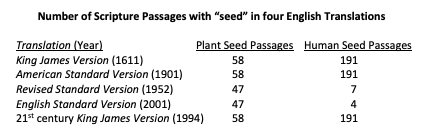
The RSV translation deletes seed from Lev 12:2 and Heb 11:11, and changed seed to children in Num 5:28. These changes are examples of the vast deletion/change of seed from 96% of the ASV, ERV and KJV seed passages in the RSV. In the RSV, only 7 of those original 191 passages retain the word seed for human offspring (see table below).
LESSON 2: The early human embryo and the plant seed
In humans, the male sperm (male gamete) travels through the uterus and up the fallopian tubes in the female to fertilize one egg (female gamete). This fusion of the male and female gametes in the human is called fertilization, the two gametes join and their chromosomes combine, so that the fertilized egg contains a normal complement of chromosomes from each parent. To see a diagram of fertilization on Day 0 go to: https://commons.wikimedia.org/wiki/File:Human_Fertilization.png. Watch this process at https://www.youtube.com/watch?v=ytvjRpNLo-U
In plants, a pollen grain lands on a flower and grows a tiny tube, all the way down to reach the ovary deep in the flower of the plant. This pollen tube carries a male gamete to meet a female gamete in an ovule. In a process fertilization, the two gametes join and their chromosomes combine, so that the fertilized cell contains a normal complement of chromosomes, with some from each parent flower. Watch this process at https://www.youtube.com/watch?v=vMyKhxCEy1Q
After fertilization in humans, the human embryo (zygote) will divide into a blastocyst that is made of many cells. As the early embryo is developing during this stage, it is traveling down the mother’s fallopian tube into the uterus of the mother by 5-7 days after fertilization. All the cells in the blastocyst (human embryo at day 5-7) will give rise to the baby and the extraembryonic tissues that are the placenta, amniotic sac and umbilical cord. In other words, the early human embryo contains the cells that will give rise to the entire baby as well as those structures necessary for the embryo to obtain basic nutrients from his/her mother. To see a diagram of a human blastocyst go to: https://commons.wikimedia.org/wiki/File:Diagram_of_Blastocyst_stage.png
Watch the implantation of the blastocyst here and the early development of the embryo, placenta, and umbilical cord: https://www.youtube.com/watch?v=kj5j6T2T04I
After fertilization in plants, the fertilized ovule goes on to form a seed, which contains a food store (cotyledon), embryonic leaf (plumule) and root (radicle), which will later grow into a new plant. In other words, the seed contains the cells that will give rise to the entire plant as well as the root system needed to obtain nutrients from the soil and a food store for early embryonic development. To see a labeled diagram of a seed go to: https://quizlet.com/za/331912072/parts-of-a-seed-and-a-plant-diagram. Watch this process at: https://www.youtube.com/watch?v=8Y5BRMCo-00
The human embryo (blastocyst) implants in the wall of the mother’s uterus. The blastocyst reaches the uterus by day 7 and attaches to the uterine wall. The cells that will give rise to the placenta (the trophoblast cells in the human embryo or blastocyst) will grow deeper into the uterine tissue to exchange gases and water with the vascular system of the mother. The placenta becomes a “root” system for the developing embryo that will provide water, gases and small molecules to the embryo for the remaining nine months of pregnancy. To see a diagram of this process go to: https://babygest.com/en/embryo-implantation/implantation-process
Watch this process at: https://www.youtube.com/watch?v=1KL8HAm3uSY
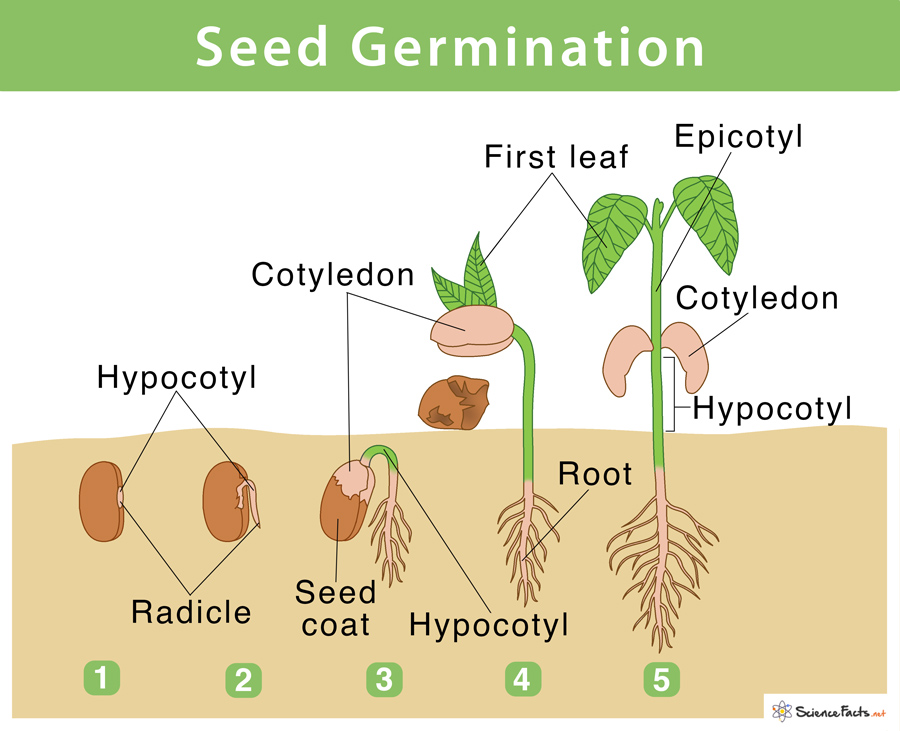
The plant seed lands in soil where it will germinate. With the germination of the seed, water is absorbed by the embryonic plant (seed) through the primary root, embryonic stem (hypocotyl) which is already present in the seed. A young shoot or embryonic leaf (plumule) is also in the seed, which will emerge. Photosynthesis using energy from the sun will utilize the nutrients and elements in the soil drawn into the plant through the root system to support the plant growth. To see a diagram of this process go to: https://www.sciencefacts.net/wp-content/uploads/2020/10/Seed-Germination-Diagram.jpg
Watch this process at: https://www.youtube.com/watch?v=taaiH3XdSxw
In summary, the seed is an accurate term for the earliest stage of human life, as there are four similarities shared in human and plant development:
l. Both the human embryo and plant seed are the result of the fertilization of the female gamete by the male gamete.
2. Both the human embryo and plant seed contain the instructions (in DNA, RNA, protein) necessary to make the entire organism.
3. Both the human embryo and plant seed travel away from the site of fertilization to a site of “planting” in a surface that will provide nourishment for the growing embryo (human or plant).
4. Both the human embryo and plant embryo develop a “root system” that is necessary for the uptake and exchange of molecules necessary for growth and development.
The parallels between early human and plant development shed light on the significance of using the term “seed” to refer to the earliest stages of human life in 191 passages across the New and Old Testaments.
LESSON 3: A comparison of the number of “seed” passages used in old and “modern” English translations
The American Standard Version of the English Bible (1901), the English Revised Version (1881) and the older King James Version (1611) use “seed” to refer to a plant seed in 58 passages, and to refer to human offspring in 191 passages (see table below). In contrast, the Revised Standard Version (1952) and English Standard Version (2001) use “seed” to refer to a plant seed in most of the same number of passages, 47 versus 58 in the older English translations (KJV, ERV, and ASV). However, there is a dramatic decrease in the use of “seed” for human offspring in both the Old and New Testaments in the RSV and the ESV Bibles (see table above). Only 7 passages in the RSV, as compared to the 191 in KJV and ASV translations, use “seed” to refer to human offspring in the Bible.
In summary, any changes in the reference to plant seed were minor in comparison to the significant deletion/changes of seed to refer to the earliest stage of human life when comparing the KJV/ERV/ASV to the RSV/ESV English translations.
Before diving deeper into the use of seed for human embryos, let’s take a look at the immediate response to the RSV Bible by conservative theologians in the next lesson.
LESSON 4: The significance of the Revised Standard Version (RSV) of 1952
The Revised Standard Version (RSV) was published in 1952 and was a revision of the American Standard Version (ASV) of 1901. The RSV was published by the Division of Christian Education of the National Council of the Churches of Christ in the USA. The goal was to produce a readable and literally accurate modern English translation which aimed to preserve all that is best in the English Bible while putting the message of the Bible in simple, enduring words. See Preface to Revised Standard Version (2nd ed., 1971) here: http://www.bible-researcher.com/rsvpreface.html
Immediately, the RSV met with opposition from conservative Protestant theologians. Several faculty from the Dallas Theological Seminary reported their concerns in “A Critique of the Revised Standard Version”, Bibliotheca Sacra Vol 110 (Jan 1953) pp. 50-66 https://www.bible-researcher.com/rsv-bibsac.html
One concern mentioned in this article is the contrast between the high regard for a strict adherence to the ancient Hebrew Text in the ASV (1901), versus the lowered view of the reliability of the Massoretic Text of the Hebrew Bible and relying on the basis of linguistic science in the RSV (1952) translation. This was one of many concerns raised by the faculty at the Dallas Theological Seminary regarding the RSV, in comparison to the ASV, described in this article.
The deletion/change of the word “seed” in 184 passages that referred to human offspring in the ASV Bible was never addressed in the preface of the 1952 RSV Bible, nor in the subsequent RSV edition published in 1972, nor in the New Revised Standard Version (NRSV) in 1989, nor in the English Revised Version (ESV) in 2001, the latter which used the RSV as its starting point. So, the deletion/change of the reference to human “seed” in the vast majority of passages across both the Old and New Testament has never been addressed until now.
LESSON 5: Given the influence of the RSV on all subsequent modern translations of the English Bible, is there any alternative to reading the KJV from 1611 (or the ASV from 1901)?
YES!!! In 1994, the 21st Century King James Version was published but has not gained the popular attention that other English translations (NIV, NASB and NKJV, to name a few) have received in the last 30 years.
What is the 21st Century King James Version of the English Bible? “It is an updated version of the King James Version Bible that stays true to the Textus Receptus, and does not delete Bible passages based on the Alexandrian Greek manuscripts. In contrast to the New King James Version (NKJV), it does not alter the language significantly from the 1611 King James Version, but it does attempt to replace some of the vocabulary that might no longer make sense to a modern reader.” From https://en.wikipedia.org/wiki/21st_Century_King_James_Version
Did this mean that the 21 century King James Version of the Bible did not follow the example of the RSV from 1952? YES and there is no change in the use of “seed” for human offspring between the 1611 KJV, and the 21 century KVJ Bible.
LESSON 6: Now the significance of “seed” has been established, why would “seed” be used by Hebrew and Greek writers of Scripture to refer to the human embryo
An obvious answer is that the growth of a seed would be understandable to people across time, especially to people who were dependent on growing their own food, who lived before the Industrial Revolution in the late 1800’s. Only since the Industrial Revolution, and the growth of cities and factories in the 1800’s, have most people become dependent on buying their food, rather than growing it themselves.
Question: How do we know that long before the Industrial Revolution someone would know that a “seed” in Scripture meant a human embryo
Martin Luther (1483-1546) was a theologian who translated the Bible from Hebrew and Greek into German, the language his neighbors could read. He completed his translation of the New Testament from Greek to German in 1522 and the Old Testament from Hebrew to German in 1534. That was about 500 years or half a millennium ago
Let’s look at how Luther translated two verses that we examined earlier in Lesson 1: Numbers 5:28 and Hebrews 11:11. These important verses defined what was conceived as “seed”. How did Luther translate these verses
Numbers 5:28 (Luther translation): …daß sie kann schwanger warden.
Numbers 5:28 (English translation of Luther’s German): …that she may become pregnant.
Numbers 5:28 (KJV): …and [she] shall conceive seed.
From this comparison we can see that Luther translated this verse to mean that Sara would become pregnant which is what conceiving seed means, if we follow the Hebrew meaning of the word “seed” to mean human being from the moment of conception.
Let’s look at another passage examined in Lesson 1, this time from the New Testament, Hebrew 11:11.
Hebrew 11:11 (Luther translation): …daß sie schwanger ward und gebar über die Zeit ihres Alters; denn sie achtete ihn treu, der es verheißen hatte.
Hebrew 11:11 (English translation of Luther’s German): …that she became pregnant and gave birth over the time of her age.
Hebrew 11:11 (KJV): …Sara herself received strength to conceive seed, and was delivered of a child when she was past age.
In translating both Hebrew and Greek into German, Luther says that to “conceive seed” means “became pregnant“, which is exactly correct. Luther was not a physician, nor did he live in the 21st century, but he correctly and precisely translated the Word of God for the German people. He interpreted “seed” from both the Hebrew and Greek text to mean the conception of human life which is when a woman becomes pregnant.
LESSON 7: Psalm 139 describes the development of the human being in the earth without using the word “seed”.
Psalm 139:13-16 is still recognized in modern English translations to refer to human embryonic development. The analogy presented in these passages is of a seed’s development in the earth:
Psalm 139:13-16 (KJV) Written by David, describing his calling by God in the womb:
For thou hast possessed my reins: thou hast covered me in my mother’s womb.
I will praise thee; for I am fearfully and wonderfully made: marvellous are thy works; and that my soul knoweth right well.
My substance was not hid from thee, when I was made in secret, and curiously wrought in the lowest parts of the earth.
Thine eyes did see my substance, yet being unperfect; and in thy book all my members were written, which in continuance were fashioned, when as yet there was none of them.
Psalm 139:13-16 (NIV):
For you created my inmost being;
you knit me together in my mother’s womb.
I praise you because I am fearfully and wonderfully made;
your works are wonderful, I know that full well.
My frame was not hidden from you
when I was made in the secret place,
when I was woven together in the depths of the earth.
Your eyes saw my unformed body;
all the days ordained for me were written in your book
before one of them came to be.
This passage is consistent with the use of “seed” in 191 passages of the KJV, referring to the earliest stage of human life as represented by a seed developing in the earth. It also identifies the very first day of human life as known and recognized by God.
Question: What about the two other popularly cited passages regarding early human life?
The two other commonly cited passages today that speak to the earliest stage of human life are:
Jeremiah 1:4-5 (KJV, Written by Jeremiah, describing his calling by God in the womb).
Then the word of the Lord came unto me, saying,
Before I formed thee in the belly I knew thee; and before thou camest forth out of the womb I sanctified thee, and I ordained thee a prophet unto the nations.
Galatians 1:15 (KJV, Written by Paul, describing his calling by God in the womb).
But when it pleased God, who separated me from my mother’s womb, and called me by his grace,
All three of these passages, Psalms 139, Jeremiah 1, and Galations 1, record the calling of three specific people to be God’s servants during their development in the womb: King David in Psalm 139, the prophet Jeremiah in Jeremiah 1 and Paul in Galatians 1.
Does God speak to ALL humanity from the moment of conception, or to just these three men? The answer is God does address ALL of humanity at conception as evident when we return to the KJV/ASV translations. In other words, when we return to the original Hebrew and Greek words of “seed” for human offspring and understand their usage in the KJV translation, it is clear that God addresses humanity from the moment of conception in His covenants.
LESSON 8: Biblical References of Early Human Life as Seed in Hebrew and Greek
The Bible references the earliest stage of human life in both the Old and New Testaments 191 times (OT = 157 passages, NT = 34 passages). In both Hebrew and Greek passages, the word “seed” refers to human offspring in all of these passages.
A search of Strong’s Concordance for “seed” returns 280 hits in 254 verses in the KJV (from both Old and New Testaments).
- In Hebrew, Strong’s H2233 – zera is the word “seed” which translates as children, offspring, descendants in 157 passages in the OT.
- In Greek, Strong’s G4690 – sperma is the word “seed” which translates as product of semen, children, offspring, progeny in 34 passages in the NT.
- The only use of “seed” to mean male sperm is found in Leviticus 15, in verses 16, 17, 19, and 32. There “seed” is qualified as “seed of copulation” as found in Leviticus 15:16: “And if any man’s seed of copulation go out from him, then he shall wash all his flesh in water and be unclean until the evening.”
Specifically, as we saw in Lesson 1 above, the product of human conception is called “seed” in Hebrews 11:11:
“Through faith also Sara herself received strength to conceive seed, and was delivered of a child when she was past age, because she judged him faithful who had promised.” (KJV)
Psalm 139:15 also uses the analogy of a seed growing in the earth to describe the earliest stages of human life:
“My substance was not hid from thee, when I was made in secret, and curiously wrought in the lowest parts of the earth. Thine eyes did see my substance, yet being unperfect; and in thy book all my members were written, which in continuance were fashioned, when as yet there was none of them.” (KJV)
1 Corinthians 15:38 says that God gives the human life (or seed) his/her body:
“But God giveth it a body as it hath pleased him, and to every seed his own body.” (KJV)
Finally, Psalm 51:5 tells us that human beings are in need of a Savior from the moment they are conceived:
“Surely I was sinful at birth, sinful from the time my mother conceived me.” (NIV)
This last passage, Psalm 51:5, establishes the need for a Savior for each person from the moment he/she is conceived. It is not surprising then that God directs His covenantal promises to human beings from the moment of their conception throughout the Old and New Testament. God’s Covenant with Abraham, Moses and David point to the New Covenant of salvation through the death and resurrection of Jesus Christ. The first reference (Genesis 3:15) and the last references Revelation (12:17) to human offspring as “seed” in Scripture refer to the same event: the fulfillment of all covenants through the conception of Jesus Christ.
LESSON 9: Human “seed” and its Scriptural Meaning – God addressing human beings in all four Covenants He made with humans
Now that the biological similarity between the plant seed and the early human embryo has been explained, let’s take a closer look at where in Scripture human offspring are referred to as “seed”. The most prevalent context where “seed” is used for human offspring are in the passages where God makes His covenants with humans throughout the Old Testament and in the New Testament.
The Seed is the object of God’s words of promise spoken to His people in covenants made to humans (Noahic, Abrahamic, Mosaic, Davidic and New Covenant). The use of the term “seed” in each of the following passages from KJV, these covenants were made between God and human beings from the moment of conception.
Noahic Covenant: A covenant God established with Noah, his descendants and all living creatures after the flood that the world would never be destroyed by a flood again. God set a rainbow in the sky as a symbol of this covenant for future generations. Since all humans living today are descendants of Noah’s family that survived and reproduced after the flood, this covenant applies to all humankind.
Genesis 9:9, 11: 9And I, behold, I establish my covenant with you, and with your seed after you…11 And I will establish my covenant with you, neither shall all flesh be cut off any more by the waters of a flood; neither shall there any more be a flood to destroy the earth. (KJV)
Abrahamic Covenant: A covenant God made with Abraham that He was going to make a great nation from Abraham that through Abraham, He will bless all the families of the earth. This covenant also included inheriting the land that God would show him, “the promised Land”.
Genesis 13:15: 15 For all the land which thou seest, to thee will I give it, and to thy seed for ever. (KJV)
See additional passages in Appendix A: Genesis 15:18; Genesis 16:10; Genesis 17:7-10, 12; Genesis 17:19; Genesis 21:12; Genesis 22:17, 18; Genesis 24:7; Genesis 24:60; Genesis 26:3, 4; Genesis 26:24; Genesis 28:4; Genesis 28:13, 14; Genesis 35:12; Genesis 48:4; Genesis 48:19; Exodus 32:13; Exodus 33:1; Deuteronomy 1:8, Deuteronomy 34:4; Joshua 24:3, 2 Chronicles 20:7; Nehemiah 9:8, Psalm 105:6; Psalm 106:27; Isaiah 41:8; Isaiah 43:5; Isaiah 44:3; Isaiah 45:19, 25; Isaiah 48:19; Isaiah 61:9, Jeremiah 33:25, 26; Luke 1:55; John 8:33, 37; Acts 3:25; Acts 7:5, 6; Romans 4:13, 16, 18; Romans 9:7, 8; Romans 11:1; 2 Corinthians 11:22; Hebrews 11:11, 18.
Mosaic Covenant: A covenant made between God and the nation of Israel at Mt. Sinai after God saved the Hebrews from slavery in Egypt. This covenant is linked to the Abrahamic Covenant, in that, Moses led the Israelites into the promised land known as Canaan, that promised in the Abrahamic Covenant. In addition, the Mosaic Covenant includes the Ten Commandments and the entirety of the laws that Moses delivered from God in the five books of the Torah.
This covenant is linked to the actual fulfillment of the Abrahamic covenant regarding “the promised Land” to Abraham is realized as the Israelites are rescued from Egypt and led to Canaan by Moses. The laws made this covenant an instruction on how the Israelites were expected to love God and serve Him.
Leviticus 18:21: 21 And thou shalt not let any of thy seed pass through the fire to Molech, neither shalt thou profane the name of thy God: I am the Lord. (KJV)
See additional passages in Appendix B: Exodus 28:43; Exodus 30:21; Leviticus 20:2; Leviticus 21:15; Leviticus 21:17; Leviticus 21:21; Leviticus 22:3, 4; Numbers 14:24; Numbers 18:19; Numbers 25:13; Deuteronomy 4:37; Deuteronomy 10:15; Deuteronomy 11:9; Deuteronomy 30:6, 19; Deuteronomy 28:46, 59; Deuteronomy 31:21; Ezekiel 20:5, Psalm 106:27
Davidic Covenant: A covenant made to David through Nathan the prophet between God and David which promises David and Israel that the Messiah would come from the lineage of David and the tribe of Judah, and the Messiah would establish a kingdom that would endure forever. In addition, God tells David that he has appointed a place for His people Israel, that they may dwell in a place of their own (the Promised Land). This covenant clearly recalls the Abrahamic Covenant as well as points toward the New Covenant.
2 Samuel 7:12: 12 “And when thy days be fulfilled, and thou shalt sleep with thy fathers, I will set up thy seed after thee, which shall proceed out of thy bowels, and I will establish his kingdom.” (KJV)
See additional passages in Appendix C: 2 Samuel 22:51; 1 Kings 2:33; 1 Chronicles 16:13; 1 Chronicles 17:11; Psalm 18:50; Psalm 22:23; Psalm 22:30, 31; Psalm 25:13; Psalm 69:36; Psalm 89:3, 4; Psalm 89:29; Psalm 89:36; Psalm 102:28.
New Covenant: This covenant is the promise that God makes with humanity that He will forgive sin and restore fellowship with those who accept the atoning sacrifice of Jesus Christ as Lord and Savior. This covenant is first foreshadowed in Genesis 3:15, then by Moses (Deuteronomy 28:4) and in the Psalms, Isaiah, Jeremiah (Jeremiah 31:31, 33), and Ezekiel (Ezekiel 36:26-27).
Genesis 3:15: 15 “And I will put enmity between thee and the woman, and between thy seed and her seed; it shall bruise thy head, and thou shalt bruise his heel.” (KJV)
See additional passages in Appendix D: Isaiah 6:13; Isaiah 53:10; Isaiah 54:3; Isaiah 59:21; Isaiah 65:9, Isaiah 65:23; Isaiah 66:22; Jeremiah 23:8; Jeremiah 30:10; Jeremiah 31:36, 37; Jeremiah 33:22; John 7:42; Acts 13:23; Romans 1:3; Galatians 3:16, 19, 29; 2 Timothy 2:8; Hebrews 2:16; 1 John 3:9, Rev 12:17.
NOTE: The first reference (Genesis 3:15) and the last references Revelation (12:17) to human offspring as “seed” in Scripture refer to the same event: the fulfillment of all covenants through the conception of Jesus Christ. The earliest stage of human life (the human seed) is included in all five of the covenantal promises made by God to His people.
Why this issue is important today?
Over the past 70 years, there have been significant changes in the definition of pregnancy and understanding of when a human life begins. Traditionally and biologically, human life begins with the fertilization of an egg by sperm. This event, called fertilization, results in the embryo, called a zygote. This zygote begins to divide into two cells and the process of cell division and cellular differentiation continues throughout the lifetime of the human. This process stops only upon death. The beginning of a human’s life is at the moment of fertilization or otherwise called “conception.” This definition of when human life begins is still taught as scientifically accurate in college Biology courses.
However, in 1965, the American College of Obstetricians and Gynecologists (ACOG) adopted a different definition of “conception”, that being the implantation of the early embryo into the uterine wall, a week after fertilization (American College of Obstetricians and Gynecologists Terminology Bulletin. Terms Used in Reference to the Fetus. No. 1. Philadelphia: Davis, September, 1965.) This definition was further clarified in 1972 as the implantation of the human blastocyst (5-7 day old human embryo) in the uterine wall of the mother (Hughes, E.C. “Gametogenesis and Fertilization”, in Obstretic-Gynecologic Terminology. Philadephia: Davis, 1972: 299-304.)
The implantation of the early human embryo takes place between 5-7 days after fertilization, when the embryo is a blastocyst (multicellular embryo). This semantic change masked the potential of oral contraceptives to kill a new human life (as an abortifacient), since “conception” took place with the embyro’s implantation in the mother’s uterine wall, a week after the fertilization of the human egg by sperm, forming the zygote.
With this change in the medical definition of “conception”, a contraceptive drug or device would not be viewed as inducing an abortion (termination of pregnancy) if the implantation of the 5-7 day old human embryo was blocked.
The ACOG’s definition of “contraception”, that being the implantation of the early embryo in the uterine wall, continues today and is used to mask the abortive nature of several methods of terminating an early pregnancy, under the guise of “contraception.”
For example, Plan B (Emergency Contraception Pill) is promoted as not being an abortion pill. That depends entirely on when in the woman’s cycle the pill is ingested. If the egg that the woman ovulates monthly has been fertilized by male sperm, Plan B can work to block the process of implantation of the early embryo into the mother’s uterine wall. This constitutes the early termination of a pregnancy.
This point is described: https://www.nationalreview.com/2014/10/yes-plan-b-can-kill-embryos-donna-harrison/ and in https://lozierinstitute.org/emergencycontraceptives/.
Another example of “contraception” that can act to kill an early human embryo is the Copper-T IUD (Paragard T 380) which emits copper ions that is toxic to not only sperm and egg, but also to embryos, blocking their implantation into the uterine wall.
Similarly, Ella (Ulipristal) blocks the embryo’s implantation by altering the endometrium of the uterus. Both Ella and the popular abortion pill RU-486 act by blocking progesterone receptors in the endometrium, the latter which are necessary for implantation and the development of the early embryo after implantation. (RU-486 also acts on the embryo post-implantation resulting in a chemically induced abortion up to 8 weeks after fertilization).
The change in the definition of “contraception” by the ACOG described above, has also opened the door to the use of human embryos conceived in the laboratory to be used in medical research. The conception, growth and use of early human embryos as laboratory animals has gone largely unnoticed by the general public and news media. However, it is clearly documented and discussed in the scientific community. For an example, read: https://bmcmedethics.biomedcentral.com/articles/10.1186/s12910-017-0198-5
One “advancement” in medical research has been growing lab-conceived human embryos for longer than 14 days post-fertilization. This is well beyond the point at which the embryo would implant in a woman’s uterine wall. By culturing the human embryo outside the womb, the scientist is “technically” outside the bounds of “pregnancy” since the ACOG medical definition from 1965 required that a human embryo be implanted in the uterine wall to constitute a “conception” and thus, the beginning of pregnancy.
Not only is this taking place in laboratories in the world, but scientists are discussing how to extend the life of these early human embryos in culture so they can ask more questions regarding development. Two recent articles that discussed this were:
K. Powell (2021). What’s next for lab-grown human embryos? Researchers are now permitted to grow human embryos in the lab for longer than 14 days. Here’s what they could learn. Nature 597 (Sept 30 2021): 22-24.
E. Svoboda (2021). Frontier of development: Keeping human embryos alive in a dish is getting easier. But as the technological and regulatory landscape shifts, fresh ethical questions are coming to the fore. Nature 597 (Sept 30 2021):S15-S17.
The bottom line is that human embryos are conceived in laboratories, experimented with, and then destroyed when their purpose is served, like any laboratory animal. The change in the ACOG medical definition of “contraception” (that being after implantation) has opened the door to any human embryo that is grown outside the womb as fair game for experimentation.
All of these changes have taken place since the 1960’s, upon the introduction of the first birth control pills or contraceptive devices. This website explores the earliest stage of human life from a very different perspective, with a careful examination of God’s Word in both the Old and New Testament. The contrast between the secular understanding of the early human embryo as dispensable, or a lab animal to be experimented on, is in stark contrast to that found in the Bible. God addresses His eternal covenants to human beings from the moment of their conception, conception being the first day of life. This website presents the argument that Christians must recognize and reclaim the place the early human embryo has in these covenantal promises, which culminated in the conception, life, death and resurrection of Jesus Christ.
APPENDICES
Appendix A: Passages where “seed” is used in Abrahamic Covenant Context (KJV)
Genesis 13:15 15 For all the land which thou seest, to thee will I give it, and to thy seed for ever.
Genesis 15:18 18 In the same day the Lord made a covenant with Abram, saying, Unto thy seed have I given this land, from the river of Egypt unto the great river, the river Euphrates:
Genesis 16:10 10 And the angel of the Lord said unto her, I will multiply thy seed exceedingly, that it shall not be numbered for multitude.
Genesis 17:7-10, 12 7 And I will establish my covenant between me and thee and thy seed after thee in their generations for an everlasting covenant, to be a God unto thee, and to thy seed after thee. 8 And I will give unto thee, and to thy seed after thee, the land wherein thou art a stranger, all the land of Canaan, for an everlasting possession; and I will be their God. 9 And God said unto Abraham, Thou shalt keep my covenant therefore, thou, and thy seed after thee in their generations. 10 This is my covenant, which ye shall keep, between me and you and thy seed after thee; Every man child among you shall be circumcised.
12 And he that is eight days old shall be circumcised among you, every man child in your generations, he that is born in the house, or bought with money of any stranger, which is not of thy seed.
Genesis 17:19 19 And God said, Sarah thy wife shall bear thee a son indeed; and thou shalt call his name Isaac: and I will establish my covenant with him for an everlasting covenant, and with his seed after him.
Genesis 21:12 12 And God said unto Abraham, Let it not be grievous in thy sight because of the lad, and because of thy bondwoman; in all that Sarah hath said unto thee, hearken unto her voice; for in Isaac shall thy seed be called.
Genesis 22:17, 18 17 That in blessing I will bless thee, and in multiplying I will multiply thy seed as the stars of the heaven, and as the sand which is upon the sea shore; and thy seed shall possess the gate of his enemies; 18 And in thy seed shall all the nations of the earth be blessed; because thou hast obeyed my voice.
Genesis 24:7 7 The Lord God of heaven, which took me from my father’s house, and from the land of my kindred, and which spake unto me, and that sware unto me, saying, Unto thy seed will I give this land; he shall send his angel before thee, and thou shalt take a wife unto my son from thence.
Genesis 24:60 60 And they blessed Rebekah, and said unto her, Thou art our sister, be thou the mother of thousands of millions, and let thy seed possess the gate of those which hate them.
Genesis 26:3, 4 3 Sojourn in this land, and I will be with thee, and will bless thee; for unto thee, and unto thy seed, I will give all these countries, and I will perform the oath which I sware unto Abraham thy father; 4 And I will make thy seed to multiply as the stars of heaven, and will give unto thy seed all these countries; and in thy seed shall all the nations of the earth be blessed;
Genesis 26:24 24 And the Lord appeared unto him the same night, and said, I am the God of Abraham thy father: fear not, for I am with thee, and will bless thee, and multiply thy seed for my servant Abraham’s sake.
Genesis 28:4 4 And give thee the blessing of Abraham, to thee, and to thy seed with thee; that thou mayest inherit the land wherein thou art a stranger, which God gave unto Abraham.
Genesis 28:13, 14 13 And, behold, the Lord stood above it, and said, I am the Lord God of Abraham thy father, and the God of Isaac: the land whereon thou liest, to thee will I give it, and to thy seed; 14 And thy seed shall be as the dust of the earth, and thou shalt spread abroad to the west, and to the east, and to the north, and to the south: and in thee and in thy seed shall all the families of the earth be blessed.
Genesis 35:12 12 And the land which I gave Abraham and Isaac, to thee I will give it, and to thy seed after thee will I give the land.
Genesis 48:4 4 And said unto me, Behold, I will make thee fruitful, and multiply thee, and I will make of thee a multitude of people; and will give this land to thy seed after thee for an everlasting possession.
Genesis 48:19 19 And his father refused, and said, I know it, my son, I know it: he also shall become a people, and he also shall be great: but truly his younger brother shall be greater than he, and his seed shall become a multitude of nations.
Exodus 32:13 13 Remember Abraham, Isaac, and Israel, thy servants, to whom thou swarest by thine own self, and saidst unto them, I will multiply your seed as the stars of heaven, and all this land that I have spoken of will I give unto your seed, and they shall inherit it for ever.
Exodus 33:1 33 And the Lord said unto Moses, Depart, and go up hence, thou and the people which thou hast brought up out of the land of Egypt, unto the land which I sware unto Abraham, to Isaac, and to Jacob, saying, Unto thy seed will I give it:
Deuteronomy 1:8 8 Behold, I have set the land before you: go in and possess the land which the Lord sware unto your fathers, Abraham, Isaac, and Jacob, to give unto them and to their seed after them.
Deuteronomy 34:4 4 And the Lord said unto him, This is the land which I sware unto Abraham, unto Isaac, and unto Jacob, saying, I will give it unto thy seed: I have caused thee to see it with thine eyes, but thou shalt not go over thither.
Joshua 24:3 3 And I took your father Abraham from the other side of the flood, and led him throughout all the land of Canaan, and multiplied his seed, and gave him Isaac.
2 Chronicles 20:7 3 And I took your father Abraham from the other side of the flood, and led him throughout all the land of Canaan, and multiplied his seed, and gave him Isaac.
Nehemiah 9:8 8 And foundest his heart faithful before thee, and madest a covenant with him to give the land of the Canaanites, the Hittites, the Amorites, and the Perizzites, and the Jebusites, and the Girgashites, to give it, I say, to his seed, and hast performed thy words; for thou art righteous:
Psalm 105:6 6 O ye seed of Abraham his servant, ye children of Jacob his chosen.
Isaiah 41:8 8 But thou, Israel, art my servant, Jacob whom I have chosen, the seed of Abraham my friend.
Isaiah 43:5 5 Fear not: for I am with thee: I will bring thy seed from the east, and gather thee from the west;
Isaiah 44:3 3 For I will pour water upon him that is thirsty, and floods upon the dry ground: I will pour my spirit upon thy seed, and my blessing upon thine offspring:
Isaiah 45:19, 25 19 I have not spoken in secret, in a dark place of the earth: I said not unto the seed of Jacob, Seek ye me in vain: I the Lord speak righteousness, I declare things that are right.
25 In the Lord shall all the seed of Israel be justified, and shall glory.
Isaiah 48:19 19 Thy seed also had been as the sand, and the offspring of thy bowels like the gravel thereof; his name should not have been cut off nor destroyed from before me.
Isaiah 61:9 9 And their seed shall be known among the Gentiles, and their offspring among the people: all that see them shall acknowledge them, that they are the seed which the Lord hath blessed.
Jeremiah 33:25, 26 25 Thus saith the Lord; If my covenant be not with day and night, and if I have not appointed the ordinances of heaven and earth; 26 Then will I cast away the seed of Jacob and David my servant, so that I will not take any of his seed to be rulers over the seed of Abraham, Isaac, and Jacob: for I will cause their captivity to return, and have mercy on them.
Luke 1:55 55 As he spake to our fathers, to Abraham, and to his seed for ever.
John 8:33, 37 33 They answered him, We be Abraham’s seed, and were never in bondage to any man: how sayest thou, Ye shall be made free?
37 I know that ye are Abraham’s seed; but ye seek to kill me, because my word hath no place in you.
Acts 3:25 25 Ye are the children of the prophets, and of the covenant which God made with our fathers, saying unto Abraham, And in thy seed shall all the kindreds of the earth be blessed.
Acts 7:5, 6 5 And he gave him none inheritance in it, no, not so much as to set his foot on: yet he promised that he would give it to him for a possession, and to his seed after him, when as yet he had no child. 6 And God spake on this wise, That his seed should sojourn in a strange land; and that they should bring them into bondage, and entreat them evil four hundred years.
Romans 4:13, 16, 18 13 For the promise, that he should be the heir of the world, was not to Abraham, or to his seed, through the law, but through the righteousness of faith.
16 Therefore it is of faith, that it might be by grace; to the end the promise might be sure to all the seed; not to that only which is of the law, but to that also which is of the faith of Abraham; who is the father of us all,
18 Who against hope believed in hope, that he might become the father of many nations, according to that which was spoken, So shall thy seed be.
Romans 9:7, 8 7 Neither, because they are the seed of Abraham, are they all children: but, In Isaac shall thy seed be called.
8 That is, They which are the children of the flesh, these are not the children of God: but the children of the promise are counted for the seed.
Romans 11:1 11 I say then, Hath God cast away his people? God forbid. For I also am an Israelite, of the seed of Abraham, of the tribe of Benjamin.
2 Corinthians 11:22 11 I say then, Hath God cast away his people? God forbid. For I also am an Israelite, of the seed of Abraham, of the tribe of Benjamin.
Hebrews 11:11, 18 11 I say then, Hath God cast away his people? God forbid. For I also am an Israelite, of the seed of Abraham, of the tribe of Benjamin.
18 Of whom it was said, That in Isaac shall thy seed be called:
Appendix B: Passages where “seed” is used in Mosaic Covenant Context (KJV)
Exodus 28:43 43 And they shall be upon Aaron, and upon his sons, when they come in unto the tabernacle of the congregation, or when they come near unto the altar to minister in the holy place; that they bear not iniquity, and die: it shall be a statute for ever unto him and his seed after him.
Exodus 30:21 21 So they shall wash their hands and their feet, that they die not: and it shall be a statute for ever to them, even to him and to his seed throughout their generations.
Leviticus 18:21 21 And thou shalt not let any of thy seed pass through the fire to Molech, neither shalt thou profane the name of thy God: I am the Lord.
Leviticus 20:2 2 Again, thou shalt say to the children of Israel, Whosoever he be of the children of Israel, or of the strangers that sojourn in Israel, that giveth any of his seed unto Molech; he shall surely be put to death: the people of the land shall stone him with stones.
Leviticus 21:15 15 Neither shall he profane his seed among his people: for I the Lord do sanctify him.
Leviticus 21:17 17 Speak unto Aaron, saying, Whosoever he be of thy seed in their generations that hath any blemish, let him not approach to offer the bread of his God.
Leviticus 21:21 21 No man that hath a blemish of the seed of Aaron the priest shall come nigh to offer the offerings of the Lord made by fire: he hath a blemish; he shall not come nigh to offer the bread of his God.
Leviticus 22:3, 4 3 Say unto them, Whosoever he be of all your seed among your generations, that goeth unto the holy things, which the children of Israel hallow unto the Lord, having his uncleanness upon him, that soul shall be cut off from my presence: I am the Lord.
Numbers 14:24 24 But my servant Caleb, because he had another spirit with him, and hath followed me fully, him will I bring into the land whereinto he went; and his seed shall possess it.
Numbers 18:19 19 All the heave offerings of the holy things, which the children of Israel offer unto the Lord, have I given thee, and thy sons and thy daughters with thee, by a statute for ever: it is a covenant of salt for ever before the Lord unto thee and to thy seed with thee.
Numbers 25:13 13 And he shall have it, and his seed after him, even the covenant of an everlasting priesthood; because he was zealous for his God, and made an atonement for the children of Israel.
Deuteronomy 4:37 37 And because he loved thy fathers, therefore he chose their seed after them, and brought thee out in his sight with his mighty power out of Egypt;
Deuteronomy 10:15 15 Only the Lord had a delight in thy fathers to love them, and he chose their seed after them, even you above all people, as it is this day.
Deuteronomy 11:9 9 And that ye may prolong your days in the land, which the Lord sware unto your fathers to give unto them and to their seed, a land that floweth with milk and honey.
Deuteronomy 28:46, 59 46 And they shall be upon thee for a sign and for a wonder, and upon thy seed for ever.
59 Then the Lord will make thy plagues wonderful, and the plagues of thy seed, even great plagues, and of long continuance, and sore sicknesses, and of long continuance.
Deuteronomy 30:6, 19 6 And the Lord thy God will circumcise thine heart, and the heart of thy seed, to love the Lord thy God with all thine heart, and with all thy soul, that thou mayest live.
19 I call heaven and earth to record this day against you, that I have set before you life and death, blessing and cursing: therefore choose life, that both thou and thy seed may live:
Deuteronomy 31:21 21 And it shall come to pass, when many evils and troubles are befallen them, that this song shall testify against them as a witness; for it shall not be forgotten out of the mouths of their seed: for I know their imagination which they go about, even now, before I have brought them into the land which I sware.
Ezekiel 20:5 5 And say unto them, Thus saith the Lord God; In the day when I chose Israel, and lifted up mine hand unto the seed of the house of Jacob, and made myself known unto them in the land of Egypt, when I lifted up mine hand unto them, saying, I am the Lord your God;
Psalm 106:27 27 To overthrow their seed also among the nations, and to scatter them in the lands.
Appendix C: Passages where “seed” is used in Davidic Covenant Context (KJV)
2 Samuel 7:12 12 And when thy days be fulfilled, and thou shalt sleep with thy fathers, I will set up thy seed after thee, which shall proceed out of thy bowels, and I will establish his kingdom.
2 Samuel 22:51 51 He is the tower of salvation for his king: and sheweth mercy to his anointed, unto David, and to his seed for evermore.
1 Kings 2:33 33 Their blood shall therefore return upon the head of Joab, and upon the head of his seed for ever: but upon David, and upon his seed, and upon his house, and upon his throne, shall there be peace for ever from the Lord.
1 Chronicles 16:13 13 O ye seed of Israel his servant, ye children of Jacob, his chosen ones.
1 Chronicles 17:11 11 And it shall come to pass, when thy days be expired that thou must go to be with thy fathers, that I will raise up thy seed after thee, which shall be of thy sons; and I will establish his kingdom.
Psalm 18:50 50 Great deliverance giveth he to his king; and sheweth mercy to his anointed, to David, and to his seed for evermore.
Psalm 22:23 23 Ye that fear the Lord, praise him; all ye the seed of Jacob, glorify him; and fear him, all ye the seed of Israel.
Psalm 22:30, 31 23 Ye that fear the Lord, praise him; all ye the seed of Jacob, glorify him; and fear him, all ye the seed of Israel.
Psalm 25:13 23 Ye that fear the Lord, praise him; all ye the seed of Jacob, glorify him; and fear him, all ye the seed of Israel.
Psalm 69:36 36 The seed also of his servants shall inherit it: and they that love his name shall dwell therein.
Psalm 89:3, 4 36 His seed shall endure for ever, and his throne as the sun before me.
4 Thy seed will I establish for ever, and build up thy throne to all generations. Selah.
Psalm 89:29 29 His seed also will I make to endure for ever, and his throne as the days of heaven.
Psalm 89:36 36 His seed shall endure for ever, and his throne as the sun before me.
Psalm 102:28 28 The children of thy servants shall continue, and their seed shall be established before thee.
Appendix D: Passages where “seed” is used in New Covenant Context (KJV)
Genesis 3:15 15 And I will put enmity between thee and the woman, and between thy seed and her seed; it shall bruise thy head, and thou shalt bruise his heel.
Isaiah 6:13 13 But yet in it shall be a tenth, and it shall return, and shall be eaten: as a teil tree, and as an oak, whose substance is in them, when they cast their leaves: so the holy seed shall be the substance thereof.
Isaiah 53:10 10 Yet it pleased the Lord to bruise him; he hath put him to grief: when thou shalt make his soul an offering for sin, he shall see his seed, he shall prolong his days, and the pleasure of the Lord shall prosper in his hand.
Isaiah 54:3 3 For thou shalt break forth on the right hand and on the left; and thy seed shall inherit the Gentiles, and make the desolate cities to be inhabited.
Isaiah 59:21 21 As for me, this is my covenant with them, saith the Lord; My spirit that is upon thee, and my words which I have put in thy mouth, shall not depart out of thy mouth, nor out of the mouth of thy seed, nor out of the mouth of thy seed’s seed, saith the Lord, from henceforth and for ever.
Isaiah 65:9 9 And I will bring forth a seed out of Jacob, and out of Judah an inheritor of my mountains: and mine elect shall inherit it, and my servants shall dwell there.
Isaiah 65:23 23 They shall not labour in vain, nor bring forth for trouble; for they are the seed of the blessed of the Lord, and their offspring with them.
Isaiah 66:22 22 For as the new heavens and the new earth, which I will make, shall remain before me, saith the Lord, so shall your seed and your name remain.
Jeremiah 23:8 8 But, The Lord liveth, which brought up and which led the seed of the house of Israel out of the north country, and from all countries whither I had driven them; and they shall dwell in their own land.
Jeremiah 30:10 10 Therefore fear thou not, O my servant Jacob, saith the Lord; neither be dismayed, O Israel: for, lo, I will save thee from afar, and thy seed from the land of their captivity; and Jacob shall return, and shall be in rest, and be quiet, and none shall make him afraid.
Jeremiah 31:36, 37 36 If those ordinances depart from before me, saith the Lord, then the seed of Israel also shall cease from being a nation before me for ever.
37 Thus saith the Lord; If heaven above can be measured, and the foundations of the earth searched out beneath, I will also cast off all the seed of Israel for all that they have done, saith the Lord.
Jeremiah 33:22 22 As the host of heaven cannot be numbered, neither the sand of the sea measured: so will I multiply the seed of David my servant, and the Levites that minister unto me.
John 7:42 42 Hath not the scripture said, That Christ cometh of the seed of David, and out of the town of Bethlehem, where David was?
Acts 13:23 23 Of this man’s seed hath God according to his promise raised unto Israel a Saviour, Jesus:
Romans 1:3 3 Concerning his Son Jesus Christ our Lord, which was made of the seed of David according to the flesh;
Galatians 3:16, 19, 29 16 Now to Abraham and his seed were the promises made. He saith not, And to seeds, as of many; but as of one, And to thy seed, which is Christ.
19 Wherefore then serveth the law? It was added because of transgressions, till the seed should come to whom the promise was made; and it was ordained by angels in the hand of a mediator.
29 And if ye be Christ’s, then are ye Abraham’s seed, and heirs according to the promise.
2 Timothy 2:8 8 Remember that Jesus Christ of the seed of David was raised from the dead according to my gospel:
Hebrews 2:16 16 For verily he took not on him the nature of angels; but he took on him the seed of Abraham.
1 John 3:9 9 Whosoever is born of God doth not commit sin; for his seed remaineth in him: and he cannot sin, because he is born of God.
Rev 12:17 17 And the dragon was wroth with the woman, and went to make war with the remnant of her seed, which keep the commandments of God, and have the testimony of Jesus Christ.
Note: The author is adding content to the website on a regular basis as of Feb 17, 2023. There is much to be added to this important issue.
 Seeds of the Covenant